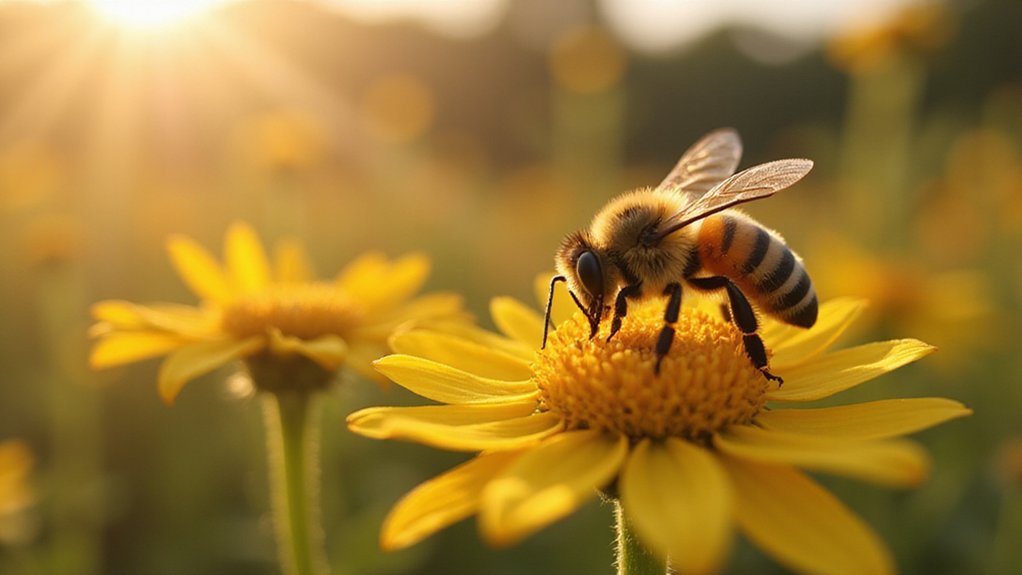
Ever wondered if that buzzing insect is a bee or something else? Many people mistake yellow jackets for bees, but they’re actually a type of wasp.
Unlike fuzzy bees that build hives, yellow jackets have smooth, shiny bodies and often nest underground or in hidden spots.
Want to know how these differences affect their behavior and how to stay safe? Keep reading.
What Are Yellow Jackets, and How Do They Differ From Bees?
Yellow jackets are a type of social wasp, not a bee, and they are commonly mistaken for one another. They are characterized by their yellow and black markings, which help differentiate them from bees. Unlike bees, yellow jackets lack the dense hair covering their bodies, giving them a shinier and hairless appearance. They are known for their aggressive behavior and play a vital role as predators in controlling pest insect populations. Instead of collecting pollen like bees, yellow jackets hunt other insects and scavenge on human food, especially during late summer. Their nests are built from chewed wood fiber and are usually located underground or inside wall cavities. While they are beneficial for ecological balance, they can become aggressive when disturbed near their nests, making it important to recognize how they differ from bees and understanding their importance in the environment. Yellow jackets’ physical traits help distinguish them from bees and are key to identifying these insects. Additionally, their nesting habits can help in safely differentiating them from bees, which typically build their hives in trees or sheltered areas. Recognizing these distinctive features is crucial for safely managing encounters with yellow jackets.
How to Identify Yellow Jackets and Honey Bees in the Field
To tell yellow jackets from honey bees, focus on their physical features and behavior. Honey bees are about 0.5 to 0.6 inches long, with a robust, rounded body covered in fuzzy hair. They typically have darker coloring overall. Yellow jackets are slightly larger, measuring 0.5 to 0.75 inches, and feature a slender, narrow waist with a smooth body. Their bright yellow and black markings are highly distinctive.
Look at their wings: honey bee wings are larger, broader, and tend to lie flat when they rest. In contrast, yellow jacket wings are shorter, fold tightly against the body, and give them a more angular appearance.
Observe flight patterns and activity: honey bees tend to move steadily and methodically around flowers, collecting nectar and pollen. Yellow jackets are more erratic and dart around food sources quickly, especially around sugary drinks or sweet food. Recognizing distinctive markings and behavior traits helps in accurate identification.
Nesting habits also vary: honey bees usually build hives inside protected cavities such as tree trunks or man-made structures, while yellow jackets often build papery nests in the ground, under eaves, or in wall cavities. Recognizing these differences allows you to identify the insect safely from a distance.
Additionally, understanding the body structure of each insect can help in their identification, as honey bees have fuzzy hair for pollen collection, whereas yellow jackets have smooth bodies suited for navigating tight spaces. Recognizing the differences in body hair can be especially helpful during close inspections.
Why Do Yellow Jackets and Bees Look Similar? Clarifying the Confusion
Yellow jackets and honey bees look similar because they share common visual cues like yellow-and-black coloration and fast flight. Both insects use bright warning colors to signal danger—a strategy known as aposematic coloration—that deters predators. However, their patterns and body features differ upon closer inspection. Yellow jackets typically have brighter, sharply defined yellow and black stripes, giving them a bold appearance. Honey bees tend to have a more subdued, golden-brown coloration with fuzzy, hairy bodies, which makes them look rounder and less sleek compared to yellow jackets.
When viewed from a distance, their small size, rapid wing movement, and quick flight can make them appear alike. But body shape and surface texture are more reliable for identification. Yellow jackets are slender, shiny, and smooth, while honey bees are more rounded, fuzzy, and hairier. Recognizing these differences can help you tell the two insects apart, reducing the chances of confusing a harmless bee with a potentially aggressive yellow jacket. Understanding these visual cues is especially important for insect identification to prevent unnecessary stings. Additionally, their different behavioral tendencies can also aid in distinguishing them in natural settings. A key distinction is in their nesting habits, which can serve as a practical identification feature.
How Yellow Jackets Behave Compared to Bees
Yellow jackets tend to be much more aggressive than bees, especially when their nests are disturbed. They often build hidden nests in underground cavities, wall voids, or sheltered areas, which can make them harder to spot. Their colonies grow quickly during warm months, and the insects defend their nests fiercely. Unlike bees, which usually sting only when threatened, yellow jackets are more likely to attack when disturbed, often defending their nests vigorously. They also exhibit opportunistic feeding behaviors, scavenging on meat, garbage, and sweet liquids, which increases the chances of contact with humans. Bees primarily focus on pollination, collecting nectar and pollen to feed their colonies and rarely exhibit aggression unless provoked. Their visible wax hives and less combative nature contrast sharply with yellow jackets’ concealed nesting sites and aggressive defense.
Do Yellow Jackets Sting Multiple Times? Understanding Their Defense
Yellow jackets can sting multiple times during a single encounter because they do not leave their stinger behind in the skin. Unlike bees with barbed stingers that get stuck and can only sting once, yellow jackets have smooth, non-barbed stingers that allow them to withdraw easily and sting again and again. This ability is especially common during defensive behavior, such as when you threaten their nest or colony. Each sting delivers venom that causes pain, swelling, and redness, and multiple stings increase your exposure to venom. Because yellow jackets are highly protective of their nests, you are more likely to be stung multiple times if you come too close or disturb their colony. Their stinger design allows them to control their stinging behavior with precision. Repeated stings can lead to serious reactions in some people, making it important to understand their defense tactics and take precautions to avoid provoking them. Understanding their stinger design helps explain why yellow jackets can sting multiple times without losing their stinger. Additionally, their ability to sting repeatedly is a key factor in their aggressive defensive behavior.
Where Do Yellow Jackets Nest, and Why Is It Dangerous?
Yellow jackets typically nest underground in abandoned rodent burrows, soil cavities, or holes in the ground. These hidden entrance points can be easily overlooked, increasing the risk of accidental disturbance. They may also build nests inside wall voids, under foundations, or in other protected indoor spaces. Aerial nests appear in trees, shrubs, or thick vegetation, while sheltered outdoor locations like patios, decks, or eaves often host colonies as well. An indicator of an active nest is a high density of yellow jackets gathering around a single opening. Disrupting these nests can provoke aggressive stinging behaviors, especially if they are near your home, garden,, or outdoor gathering areas. Yellow jackets defend their nests vigorously, which can lead to multiple stings if you accidentally disturb them. Understanding their nesting habits can help you better identify and avoid potential danger zones. For this reason, being aware of their nesting locations is vital for safety. Recognizing specific yellow jacket behaviors can also provide clues about their presence and activity levels in your environment.
Are Yellow Jackets Useful for Pest Control and Your Garden?
Yellow jackets are highly beneficial for pest control in your garden. They prey on common pests like aphids, whiteflies, caterpillars, and fly larvae, especially during peak summer insect activity. By reducing these pest populations, yellow jackets help protect your plants from damage and infestation. They also play a role in decreasing the number of flies around your garden, which can create a more pleasant outdoor environment. Additionally, yellow jackets support pollination as they forage for sweet substances, transferring pollen and improving fruit yields and wildflower reproduction. They also contribute to soil health by breaking down organic matter and decomposing dead insects, enriching the soil naturally. Understanding these ecological benefits highlights how yellow jackets assist in maintaining a balanced and healthy garden ecosystem. Ecological Benefits
How to Safely Recognize and Handle Yellow Jacket Encounters
Noticing a yellow jacket is usually easy thanks to their distinctive look and behavior. They have a smooth, hairless body with bright yellow and black stripes and a narrow waist. They are active and tend to hover around food, trash, or sugary drinks, especially late summer and fall when they are more energetic. Recognizing their aggressive nature means observing if they are buzzing near their nest or showing signs of agitation. If you see one near a nest, back away slowly and avoid sudden movements that could provoke an attack. Keep children and pets away from areas with activity to prevent stings. When handling nests, treat large or hidden ground or structural nests with caution, as they can be risky and may require professional removal. To minimize encounters, cover outdoor food and secure trash tightly, reducing what attracts yellow jackets in the first place. Understanding their nesting behavior can help prevent dangerous encounters.