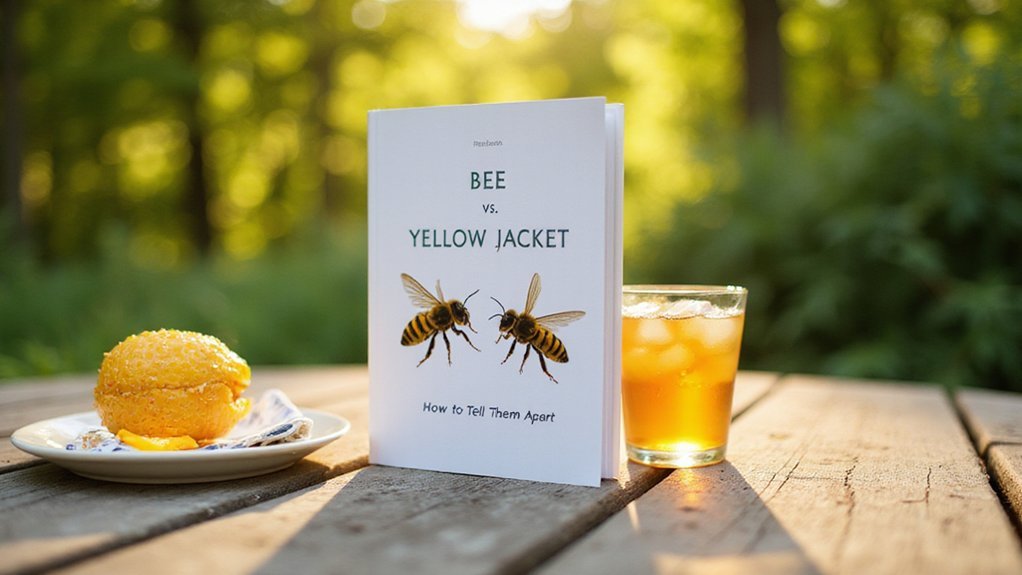
Ever wonder how to tell a yellow jacket from a honey bee? Their looks and behavior can help you distinguish between the two, especially if you’re trying to avoid getting stung.
Yellow jackets are more aggressive and have a sleek, shiny appearance, while honey bees are fuzzy and more mellow.
By understanding their key differences, you can better identify and stay safe around these insects.
Keep reading to learn the specific traits and safety tips that will help you tell them apart.
How Can You Quickly Tell Yellow Jackets From Honey Bees?
To quickly tell yellow jackets from honey bees, focus on several key differences. First, their coloration is distinct: yellow jackets have bright yellow and black markings with high contrast, while honey bees feature softer, more muted amber and golden-brown stripes. Next, observe their flight patterns. Yellow jackets tend to move rapidly, with erratic and direct flight, frequently chasing or acting aggressively if disturbed. Honey bees usually fly more calmly, especially around flowers, and are less prone to chase threats. Body texture is also a telltale sign: honey bees are fuzzy with hairy bodies, whereas yellow jackets have smooth, shiny exteriors. Combining these visual and behavioral cues makes it easier to distinguish between the two insects outdoors. Additionally, insect identification techniques can help you recognize their specific features more accurately. Recognizing insect behavior patterns can also aid in distinguishing them quickly. It’s helpful to understand their nesting habits as well, since yellow jackets often build nests underground or in sheltered areas, while honey bees prefer to establish hives in trees or man-made structures.
What Are the Key Physical Differences Between Yellow Jackets and Honey Bees?
Honey bees have fuzzy, hair-covered bodies that help them collect pollen. Their bodies are rounded and robust, with a size that typically appears more compact. They are usually amber, golden-brown, or dull yellow, with less pronounced striping. In contrast, yellow jackets have smooth, shiny, hairless exoskeletons with bright yellow and black markings that create a high-contrast pattern. Their bodies are slender with a distinct pinched waist, giving them a more streamlined appearance. While their sizes can overlap somewhat, honey bees tend to look more rounded and stocky, whereas yellow jackets appear leaner and more elongated. Additionally, the overall surface texture and hair coverage are critical physical differences that help identify these insects accurately. Recognizing body shape differences also plays an essential role in correctly identifying them in various environments. The color patterns further aid in distinguishing between the two, especially when they are not in flight.
How Do Their Behaviors Differ, Especially During Threats?
During threats, yellow jackets exhibit far more aggressive and proactive behaviors compared to honey bees. They are quick to escalate to attack when disturbed, often giving chase and mounting coordinated colony defenses. Yellow jackets are highly territorial, especially late in the season, and react aggressively to disturbances near food sources or their colony. They tend to sting multiple times and bite if necessary, showing a readiness to escalate their attack. Unlike honey bees, which usually defend only when a threat is close to the hive entrance or nest, yellow jackets can attack from a distance and pursue intruders. They can sting repeatedly without dying, making them much more unpredictable and dangerous during threats. Honey bees, on the other hand, typically sting once as a last resort and then die, limiting the potential for repeated attacks. Understanding their defensive behaviors can help in avoiding provoking either species during encounters. Recognizing their aggressive responses is essential for safe outdoor activities and effective pest management. Being aware of their territorial instincts can further help prevent unwanted stings during encounters.
Where Do These Insects Build Their Nests and What Habitats Do They Prefer?
Honey bees and yellow jackets build their nests in different habitats, each suited to their specific nesting habits. Honey bees primarily create their hives in cavities such as hollow trees, rock crevices, wall voids, and eaves of buildings. These nests are typically located about 3.5 to 16 feet above ground, in sheltered, partly shaded areas. They prefer sites close to abundant floral resources, including gardens, forests, and agricultural landscapes, because these locations provide necessary nectar, pollen, and water. Such environments support their hive maintenance and honey production.
In contrast, yellow jackets favor ground cavities like abandoned burrows in well-drained soil. They also nest in sheltered structural spaces such as wall voids, attics, and tree cavities. These wasps prefer habitats in urban, suburban, and rural areas where protected voids are accessible near food sources. Typical locations include lawns, fences, and other open areas with easy access to food, making their nests discreet yet close to scavenged resources. They also tend to be more aggressive around nesting sites, which can influence their choice of habitats. Additionally, yellow jackets may select sites with high food availability, facilitating their rapid growth and colony expansion.
What Do Honey Bees and Yellow Jackets Eat, and What Are Their Roles in Nature?
Honey bees mainly eat nectar, pollen, honey, and water. Nectar provides the sugars for energy, fueling their flight and activity. Pollen supplies proteins and nutrients necessary for brood rearing and maintaining hive health. Honey acts as stored energy during periods when foraging is limited, ensuring the colony’s survival. Water is needed to dilute honey and regulate hive temperature. These dietary choices support pollination because honey bees transfer pollen from flower to flower as they collect nectar, aiding plant reproduction and boosting biodiversity. Their role as pollinators makes them key players in maintaining healthy ecosystems and food production. Additionally, their diet plays a crucial part in their ability to perform these ecological functions effectively.
How Can You Stay Safe When Encountering Yellow Jackets or Honey Bees?
To stay safe when encountering yellow jackets or honey bees, the key is to avoid attracting them and to protect yourself. Keep food covered and trash sealed tightly to prevent scent trails that draw insects. Avoid wearing brightly colored clothing or scented products like perfumes or lotions, as these can attract bees and wasps. Wearing protective gear such as long sleeves, pants, gloves, and a hat or veil can create a barrier if you come close to a nest or a bee. Maintain a safe distance from active nests and never attempt to disturb them, especially near dense vegetation or underground cavities where they may be hiding. If a yellow jacket or bee approaches you, move away swiftly in a straight line without swatting, which could provoke a sting. If you feel threatened or are stung, seek shelter indoors or inside a vehicle immediately and have basic first aid supplies ready to treat stings.