You might worry that a pellet stove means babysitting a tiny hopper, ruining the cozy vibe. But the models we’ve found, like the Cleveland Iron Works with its 60-pound capacity or the massive 170-pound hopper on the US Stove WiFi model, change that entirely. You get hours of uninterrupted warmth, and we’ll break down the six best options.
| Cleveland Iron Works Medium Pellet Stove – 60lb Hopper |  | Best Mid-Size | Heating Area (sq ft): 1,500–2,200 sq ft | Hopper Capacity (lbs): 60 lbs | Heat Output (BTUs): 30,124 BTU | VIEW LATEST PRICE | Read Our Analysis |
| Castle Serenity Pellet Stove 1500 sq ft | 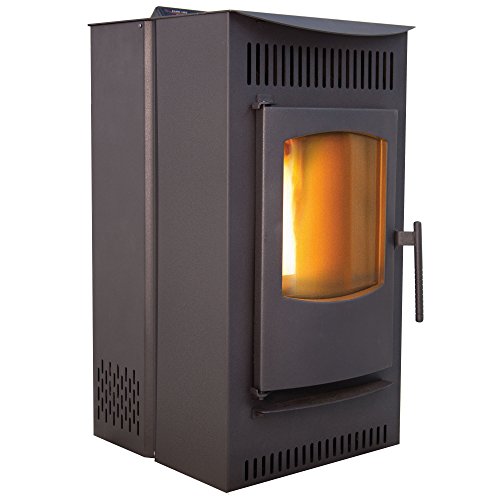 | Easiest Cleanup | Heating Area (sq ft): Up to 1,500 sq ft | Hopper Capacity (lbs): 40 lbs | Heat Output (BTUs): 32,000 BTU | VIEW LATEST PRICE | Read Our Analysis |
| US Stove GW1949 Wiseway Non-Electric Pellet Stove |  | Off-Grid Pick | Heating Area (sq ft): Up to 2,000 sq ft | Hopper Capacity (lbs): 60 lbs | Heat Output (BTUs): 40,000 BTU | VIEW LATEST PRICE | Read Our Analysis |
| Comfortbilt HP22 Pellet Stove (55 lb Hopper) |  | Most Powerful | Heating Area (sq ft): Up to 2,800 sq ft | Hopper Capacity (lbs): 55 lbs | Heat Output (BTUs): 50,000 BTU | VIEW LATEST PRICE | Read Our Analysis |
| US Stove 3,000 Sq. Ft. Pellet Stove WiFi 170lb Hopper |  | Longest Runtime | Heating Area (sq ft): Up to 3,000 sq ft | Hopper Capacity (lbs): 170 lbs | Heat Output (BTUs): 33,000 BTU | VIEW LATEST PRICE | Read Our Analysis |
| Portable Pellet Stove with Oven for Camping | 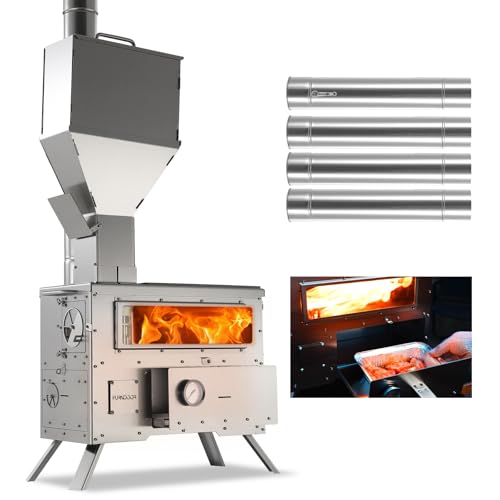 | Camping Companion | Heating Area (sq ft): Not specified (outdoor camping use) | Hopper Capacity (lbs): Not specified | Heat Output (BTUs): Not specified | VIEW LATEST PRICE | Read Our Analysis |
More Details on Our Top Picks
Cleveland Iron Works Medium Pellet Stove – 60lb Hopper
Looking for a pellet stove that hits the sweet spot between power and practicality? You’ll appreciate the Cleveland Iron Works Medium Pellet Stove with its 60 lb hopper. It heats 1,500 to 2,200 square feet, pumping out roughly 30,124 BTUs, so you’re covered for mid sized spaces. Built with solid steel and cast iron, it’s tough but not cumbersome at 183 pounds. You control it via Wi Fi, the Smart stove app, or the remote. And its Whisper Quiet Blower Technology keeps warmth circulating without noise. Plus, easy access service panels simplify maintenance. You get five years on steel parts, one on electrical.
- Heating Area (sq ft):1,500–2,200 sq ft
- Hopper Capacity (lbs):60 lbs
- Heat Output (BTUs):30,124 BTU
- Weight (lbs):183 lbs
- Dimensions (Depth x Width x Height):26.02″ x 20.55″ x 33.31″
- Fuel Type:Pellets
- Additional Feature:Wi-Fi / Smart stove app
- Additional Feature:Whisper quiet blower technology
- Additional Feature:Easy-access service panels
Castle Serenity Pellet Stove 1500 sq ft
If you want the easiest cleanup in a pellet stove, the Castle Serenity delivers. Its tubeless, easy-to-clean fire chamber means no hidden chambers to wrestle with. You’ll heat up to 1,500 sq. ft. with 32,000 BTU, and its 40-pound hopper runs about 24 hours without refueling. The smart controller gives you five burn levels plus eco mode. You can program it weekly, use the remote, or let the thermostat handle it. At 186 pounds and just 24 inches deep, it’s a space-saving workhorse. And cleanup? Seriously simple.
- Heating Area (sq ft):Up to 1,500 sq ft
- Hopper Capacity (lbs):40 lbs
- Heat Output (BTUs):32,000 BTU
- Weight (lbs):186 lbs
- Dimensions (Depth x Width x Height):24″ x 18″ x 36″
- Fuel Type:Pellets
- Additional Feature:Tubeless, easy-clean fire chamber
- Additional Feature:Five selectable burn levels
- Additional Feature:Eco mode operation
US Stove GW1949 Wiseway Non-Electric Pellet Stove
This stove is your off-grid pick for worry free heat. It’s a gravity fed beast with no moving parts, so you won’t deal with motor failures. The 60 pound hopper keeps you cozy for about 30 hours straight. Just light the pellets with a propane torch, then adjust heat through those front air intakes. You’ll get 40,000 BTUs warming up to 2,000 square feet. And it’s silent! No electricity needed, meaning blackouts don’t stop you. Watch the flame through the viewing window. Standard 3 inch venting keeps installation simple. It’s durable steel, but you’ll need to assemble it.
- Heating Area (sq ft):Up to 2,000 sq ft
- Hopper Capacity (lbs):60 lbs
- Heat Output (BTUs):40,000 BTU
- Weight (lbs):131 lbs
- Dimensions (Depth x Width x Height):24″ x 15″ x 52″
- Fuel Type:Pellets
- Additional Feature:No electricity needed
- Additional Feature:Natural gravity feed system
- Additional Feature:Uses propane torch for startup
Comfortbilt HP22 Pellet Stove (55 lb Hopper)
The Comfortbilt HP22 is the most powerful pellet stove for large open floor plans. It heats up to 2,800 square feet with a robust 50,000 BTUs, so you’ll stay cozy without constant refueling. That 55-pound hopper means longer burn times, and the auto ignition gets you started instantly. Plus, the programmable thermostat gives you precise control, adjusting heat as needed. Key features include:
- EPA and CSA certified for safety and efficiency (70%).
- A large bay viewing window, easy to clean ash pan.
- Dimensions: 25″D x 24″W x 32.5″H, weighing 285 pounds.
For open layouts, this freestanding unit delivers reliable warmth.
- Heating Area (sq ft):Up to 2,800 sq ft
- Hopper Capacity (lbs):55 lbs
- Heat Output (BTUs):50,000 BTU
- Weight (lbs):285 lbs
- Dimensions (Depth x Width x Height):25″ x 24″ x 32.5″
- Fuel Type:Pellets
- Additional Feature:Bay-style viewing window
- Additional Feature:Auto ignition feature
- Additional Feature:Programmable thermostat included
US Stove 3,000 Sq. Ft. Pellet Stove WiFi 170lb Hopper
You want a pellet stove that practically runs itself. The US Stove 3,000 Sq. Ft. model delivers exactly that, with a massive 170lb hopper that’ll keep you warm for up to 80 hours straight. No constant refueling, just steady heat.
- Heats up to 3,000 square feet with 33,000 BTUs of clean, efficient warmth.
- WiFi control through the US Stove App means you adjust settings from your phone.
- Cast iron construction with ceramic glass, plus an AURORA burner for better flame visuals.
- Electronic ignition gets you going instantly, not fumbling with matches.
- Mobile home approved with the optional Fresh Air Kit.
You’ll love topping off the hopper once, then forgetting about it for days.
- Heating Area (sq ft):Up to 3,000 sq ft
- Hopper Capacity (lbs):170 lbs
- Heat Output (BTUs):33,000 BTU
- Weight (lbs):265 lbs
- Dimensions (Depth x Width x Height):30″ x 24″ x 40″
- Fuel Type:Wood pellets
- Additional Feature:Advanced AURORA airflow burner
- Additional Feature:Electronic ignition
- Additional Feature:Mobile home approved
Portable Pellet Stove with Oven for Camping
Want a portable stove that doubles as your camping companion? The Garturects pellet camping stove offers both warmth and an oven for baking, roasting, or warming meals. You’ll see the flames through large viewing glass while you cook. This stove heats quickly thanks to wider 2.75-inch chimney pipes, but it includes adapters for standard 2.36-inch systems. It’s built from tough 304 stainless steel to handle winter weather. Compact and lightweight, it comes ready with:
- Ash scraper and hand-held lever
- Hopper and stove body
- Four chimney pipes
Burn wood or pellets for fuel flexibility. Minimal ash residue keeps cleanup easy. This stove delivers reliable heat without constant refueling.
- Heating Area (sq ft):Not specified (outdoor camping use)
- Hopper Capacity (lbs):Not specified
- Heat Output (BTUs):Not specified
- Weight (lbs):Lightweight (not specified)
- Dimensions (Depth x Width x Height):Compact/portable (not specified)
- Fuel Type:Pellets or wood
- Additional Feature:Built-in oven for cooking
- Additional Feature:304 stainless steel construction
- Additional Feature:Compatible with standard pipe adapters
Factors to Consider When Choosing a Pellet Wood Stove

When you’re picking a pellet wood stove, start by matching its heating capacity and BTU output to the size of your space. You’ll also want to take into account the hopper size, as a larger one means less frequent refueling, and the efficiency rating, which directly affects your fuel costs over time. Don’t forget to check the power requirements too, since many models need electricity to run their fans and controls.
Heating Capacity
Why does heating capacity matter so much when choosing a pellet wood stove? It directly determines whether your space feels like a warm hug or a chilly disappointment. A stove’s heating capacity is measured in BTUs, or British Thermal Units. That number tells you exactly how much heat it can pump out. You need a model that matches your room size. For example, a stove delivering around 30,124 BTUs handles mid-sized homes up to 2,200 square feet just right.
Choose a BTU rating that aligns with your space. Too low, and you’ll freeze. Too high, and you’ll waste energy, overheating a small room. Larger areas demand higher BTUs, while smaller spots work fine with less power. Getting this balance right means consistent, effective warmth without constant fiddling. It’s about matching the stove to your home’s needs, not guessing.
Hopper Size
How often do you want to babysit your stove? That’s the real question behind hopper size. Larger hoppers, ranging from 40 to 170 pounds, let you go longer between refills. A 60-pound hopper, for instance, keeps you warm for about 24 to 30 hours depending on your heat setting and pellet type. So you can load it up and forget it for a day. Smaller hoppers? You’ll be refilling more often, which is fine for a small room but a hassle for whole-house heating. When choosing, match the hopper size to the space you’re heating and your tolerance for interruptions. Want fewer fuel stops? Go big. Don’t mind a quick top-off? A compact hopper works just fine. It’s all about balancing convenience with your daily rhythm.
BTU Output
What does “enough heat” actually mean for your space? It’s all about BTU output, which measures how much heat a pellet stove cranks out per hour. Most stoves range from 20,000 to 50,000 BTUs, so you’ve got options. Pick the right one by considering:
- Room size: Higher BTUs suit larger areas. Lower ones work for small to medium rooms.
- Insulation quality: A well-insulated space needs fewer BTUs. Drafty rooms require more.
- Local climate: Colder winters demand a bigger punch.
Don’t overshoot your BTU needs, or you’ll waste energy. Undershoot, and you’ll freeze. Match the stove’s rating to your home’s specifics, not just square footage. It’s that sweet spot between cozy and efficient, no constant refueling required!
Efficiency Rating
BTU output tells you how much heat a stove can produce, but the efficiency rating shows how much of that heat actually warms your home instead of escaping up the flue. Basically, it’s the percentage of fuel energy transformed into usable warmth. You’ll want a rating above 75% for a truly efficient model that saves you money over time.
Higher efficiency means you burn less fuel, so you’ll deal with less ash and lower emissions. Plus, your stove’s design and combustion technology matter a lot. Keep it well maintained and properly installed to maximize performance. Look for EPA certifications or independent verification from the manufacturer to confirm the rating. It’s a smart shortcut to reliable, long term heat without wasting pellets!
Power Requirements
Why worry about plugging in a stove when you’re looking for cozy heat? Well, most pellet stoves need a standard 120V outlet for their fans and controls. But you’ve got two paths here. Go electric, and you’ll deal with wattage that usually sits between 77 and over 100 watts during operation. That’s less than a space heater, so your home’s wiring can likely handle it. However, if you choose a Wi-Fi model or one with a programmable thermostat, you might need a dedicated circuit to keep those remote features running smoothly. Your other option? A non-electric pellet stove. It relies on natural draft, so power requirements vanish entirely. No plug, no worry. Just make sure your electrical system can handle the load before you buy, or you’ll be resetting breakers instead of relaxing.
Venting Type
Once you’ve got the power sorted, your next big decision is how you’ll vent that stove, and this choice directly shapes where you can put it and how well it performs. You’ve got three main options here:
- Direct vent systems pull outside air for combustion and exhaust through a wall or roof. They’re airtight and highly efficient, making them a top pick for tight, energy-conscious homes.
- Power vent setups use an external blower to push fumes out, giving you placement flexibility where traditional venting won’t work. Think basements or interior rooms.
- Natural vent systems rely on gravity and heat differences, usually needing a taller chimney for proper draft. They’re simpler but less forgiving on location.
Your vent choice directly impacts installation complexity and stove efficiency, so match it to your home’s layout and your comfort with setup work.
Warranty Coverage
How do you protect your investment once that shiny new pellet stove is installed? You start by checking the warranty coverage. A solid warranty should cover electrical components for at least a year and steel parts for multiple years. Look for manufacturers that offer extended coverage; paying a little extra now can save you big on future repairs.
Read the fine print carefully. You’ll want to know if labor and parts are included and if your intended use—residential, off-grid, or commercial—is covered. Not every warranty applies to all situations.
And don’t overlook the manufacturer’s reputation. Can you easily file a claim if something goes wrong? Good customer support makes all the difference. So, pick a stove with a warranty that’s as tough as the steel it wraps around. That’s how you stay cozy without constant refueling headaches.